
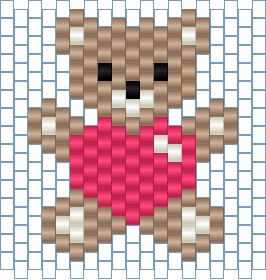
You can make this teddy with heart by using the brick stitch or peyote technique. A fun way to surprise someone and spread some love! Make a cute keychain or use it as a charm for a bracelet or necklace.
Needed supplies:
- Miyuki needle
- Beading tread
- Delica beads in the following colors: DB-2105, DB-1338, DB-51, DB-310

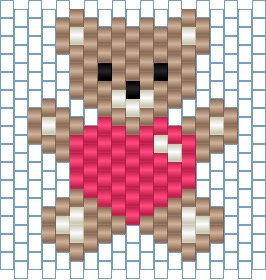
Using the brick stitch technique:
It’s best to start this pattern in the middle of the bear.
So, start the first row with the ladder stitch and work your way up. Once the first half of your bear is finished, turn it over and continue with the other half.
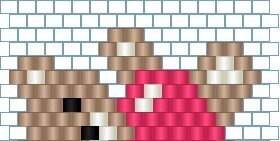
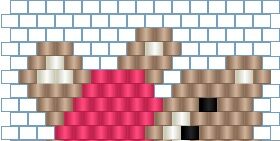
First, you string a strip using the ladder stitch, which means you string the beads next to each other. Below is an example.
You can read the extended instructions for the brick stitch technique on this page.
The peyote technique (for the experienced jewelry maker):
With this technique you can hold the bear upright and start with the widest part in the middle (arm height) of the bear.
This is the written pattern for the peyote technique, the tip is to start stringing in the middle of the pattern here as well.
Chart #:A
DB-2105
Opaque Beige Duracoat
Count:84
Chart #:B
DB-51
Transparant ab crystal
Count:15
Chart #:C
DB-1338
Silverlined dyed rose
Count:37
Chart #:D
DB-310
Matte Black
Count:3
Row 1&2 (L) (1)A, (7)Blank, (1)A
Row 3 (R) (6)A
Row 4 (L) (1)B, (3)A, (1)B
Row 5 (R) (6)A
Row 6 (L) (5)A
Row 7 (R) (4)A
Row 8 (L) (1)A, (1)D, (1)A, (1)D, (1)A
Row 9 (R) (4)A
Row 10 (L) (2)A, (1)D, (2)A
Row 11 (R) (1)A, (2)B, (1)A
Row 12 (L) (1)A, (1)Blank, (1)A, (1)B, (1)A, (1)Blank, (1)A
Row 13 (R) (2)A, (1)Blank, (2)A, (1)Blank, (2)A
Row 14 (L) (1)B, (1)A, (1)C, (1)A, (1)C, (1)A, (1)B
Row 15 (R) (2)A, (4)C, (2)A
Row 16 (L) (1)A, (1)C, (1)B, (3)C, (1)A
Row 17 (R) (1)A, (3)C, (1)B, (1)A
Row 18 (L) (5)C
Row 19 (R) (4)C
Row 20 (L) (5)C
Row 21 (R) (4)C
Row 22 (L) (1)A, (3)C, (1)A
Row 23 (R) (2)A, (2)C, (2)A
Row 24 (L) (1)A, (1)B, (1)A, (1)C, (1)A, (1)B, (1)A
Row 25 (R) (1)B, (4)A, (1)B
Row 26 (L) (1)A, (1)B, (1)A, (1)Blank, (1)A, (1)B, (1)A
Row 27 (R) (2)A, (2)Blank, (2)A
Row 28 (L) (1)A, (3)Blank, (1)A
Row 29 (R)
Row 30 (L)