
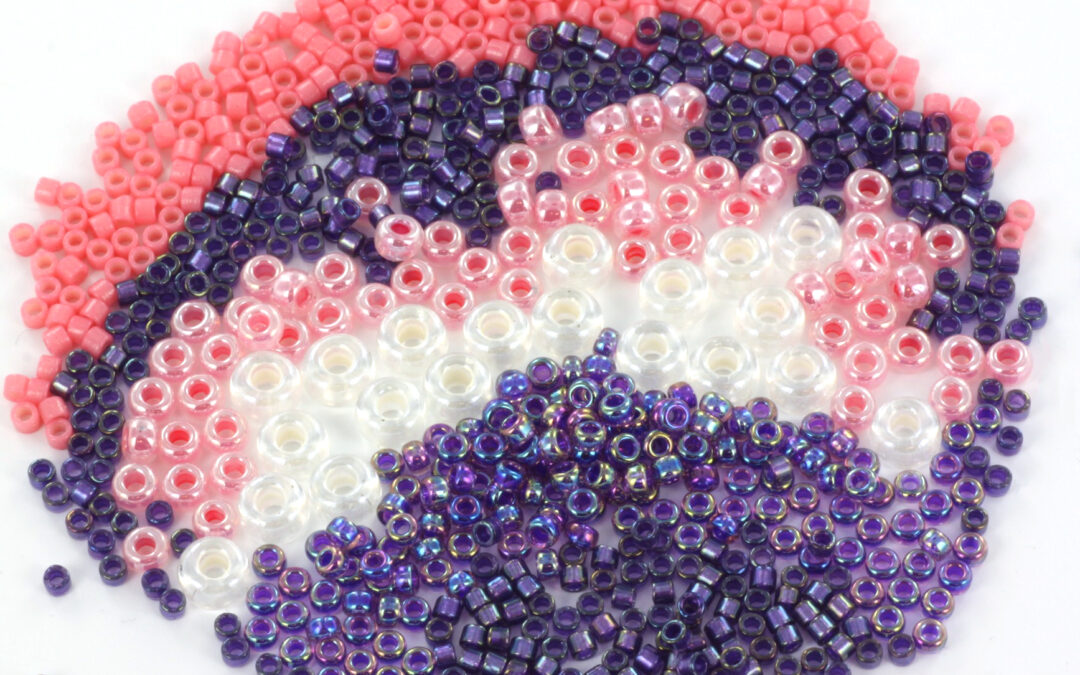
The first types you often come across, when searching for Miyuki beads, are the seed beads and the Delica beads. And that’s of course because they are the most popular shapes, as they can be used in a lot of different ways. But don’t rule out the other shapes of Miyuki, as they offer lots of possibilities, each in their own way. In this blog we tell you what shapes there are, how the names and numbers work and how to read or search for them.
The shapes of Miyuki
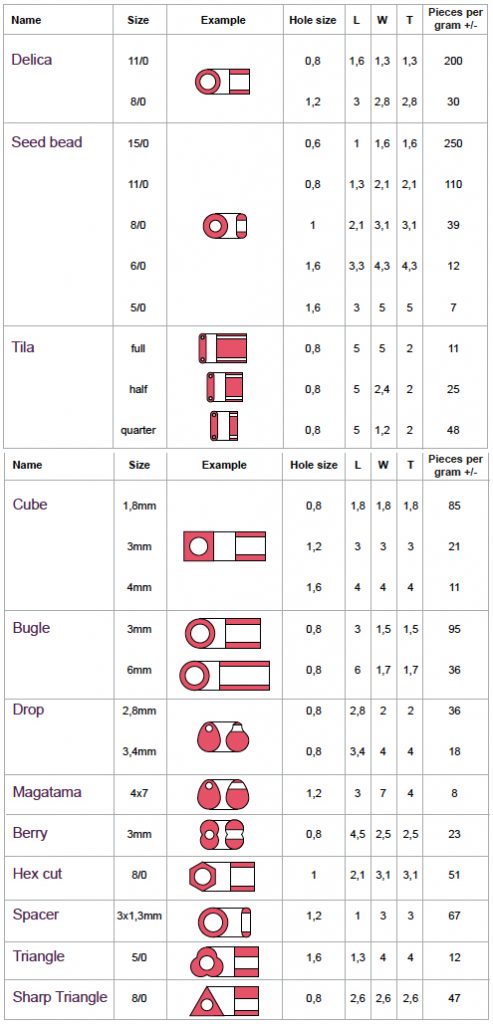
So, first we can show you the shapes of Miyuki, each of which you can use for something different. In the picture below is an overview with the dimensions and shapes of each one of them. Also, we added the number of beads that are in 1 gram in the last column. This way you will be able to order exactly enough for the project you have in mind.
The sizes of Miyuki
In the previous overview you find the size of the beads in the second column, for example 8/0 or 11/0. Most of the time shops add the size in their product numbers, for example like this: 11-401 or 8-426. So 11-401 is color number 401 in size 11/0, and 8-426 is color number 426 in size 8/0, so slightly bigger.
For Delica beads it is a little different, because the size 11/0 beads are by far the most popular ones. And for this reason most of the shops have the product numbers without the size, for example DB10 / DB-10 / DB0010. And when it is a different size, for example 8/0 or 15/0, then it is often DB08-10 or DBL-10, where the L stands for Large.
Who determines the color numbers?
Miyuki is the one who determines the color numbers of all colors, as soon as they start with the production. However, they never give a name to the colors, only the numbers.
This means that the color names are made up by the wholesalers as soon as they order them. And most of the time all wholesalers will use the color name of the first one that posted them online. It is easiest for everybody when the names match worldwide. But sometimes you can come across different names of the same color, maybe because 2 wholesalers received them at the same time. If you do, just look at the given numbers, because those are always identical and correct.
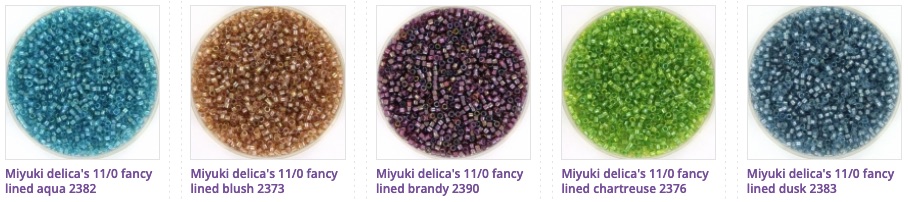
Order of color numbers from Miyuki
In terms of color numbers, Miyuki has started in the past with ascending color numbers, which resulted in the color types being grouped together. You can recognize that colors in 3 digits starting with 40 are the opaque colors, such as 11-401, 11-402, 11-403, and so on. Every 3 digits starting with 45 are metallic colors. And for example the galvanized colors with 4 digits started with 42. , for example Duracoat Galvanized is 11-4202 and 11-4203, etc.
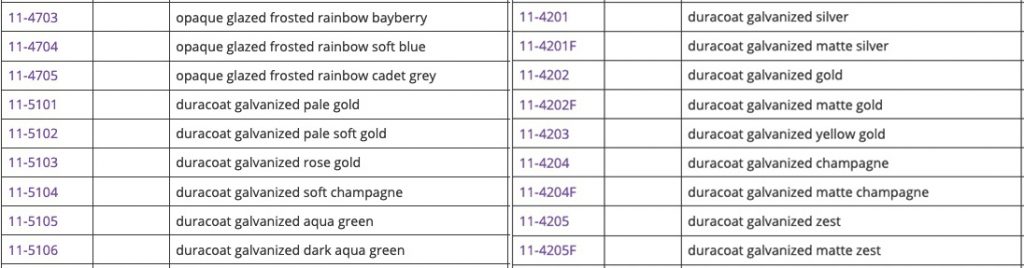
But because they have a lot of colors through the years, it was not possible to continue this sequence. Because the next numbers already belonged to other colors, they started with higher numbers, which were still available.
For example the duracoat galvanized seed beads, where the first color numbers started with 42, such as 11-4202, but also 11-4222. In 2020 they added new colors to this, and they start with 51, such as 11-5101 or 11-5107.
But despite the fact that the numbers are no longer consecutive over the years, you will be able to find it because incorporated in the name most of the time. 11-401 is opaque black, 8-539 is ceylon salmon. And if that’s not the case, just visit Miyuki’s own website, where you can complete lists of all the colors. The other option is to google the color number online, and you’ll see several results, including the name, coming up in the Google results.
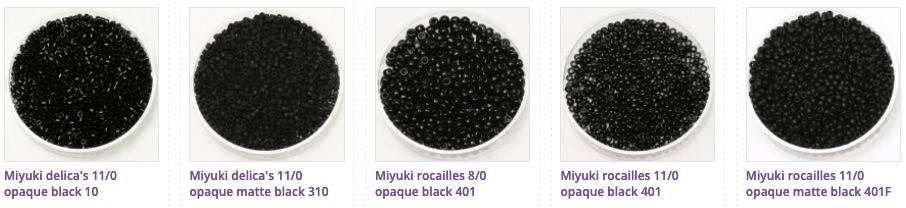
Above are the numbers of several of the ‘opaque black’ and ‘opaque matte black’. As you can see, the color number of the seed beads is different from the ones of the Delica beads. For example, opaque black is 11-401 in seed beads, but DB-10 as a Delica bead. On the website of Miyuki you can search and find all colors and find the matching numbers.
If you have any questions or recommendations after reading this, we would love to hear this.